
The Complete Guide to Japanese Hair Straightening (縮毛矯正): Pre-Consultation Tips, Suitability, and Booking Advice for Visitors to Japan
A comprehensive guide for visitors to Japan covering everything you need to know about Japanese hair straightening (縮毛矯正). Learn how to avoid damage if you have color or bleach history, get pre-consultation tips, understand total pricing, and find out how to choose a reliable salon with English-speaking staff—all before your trip.
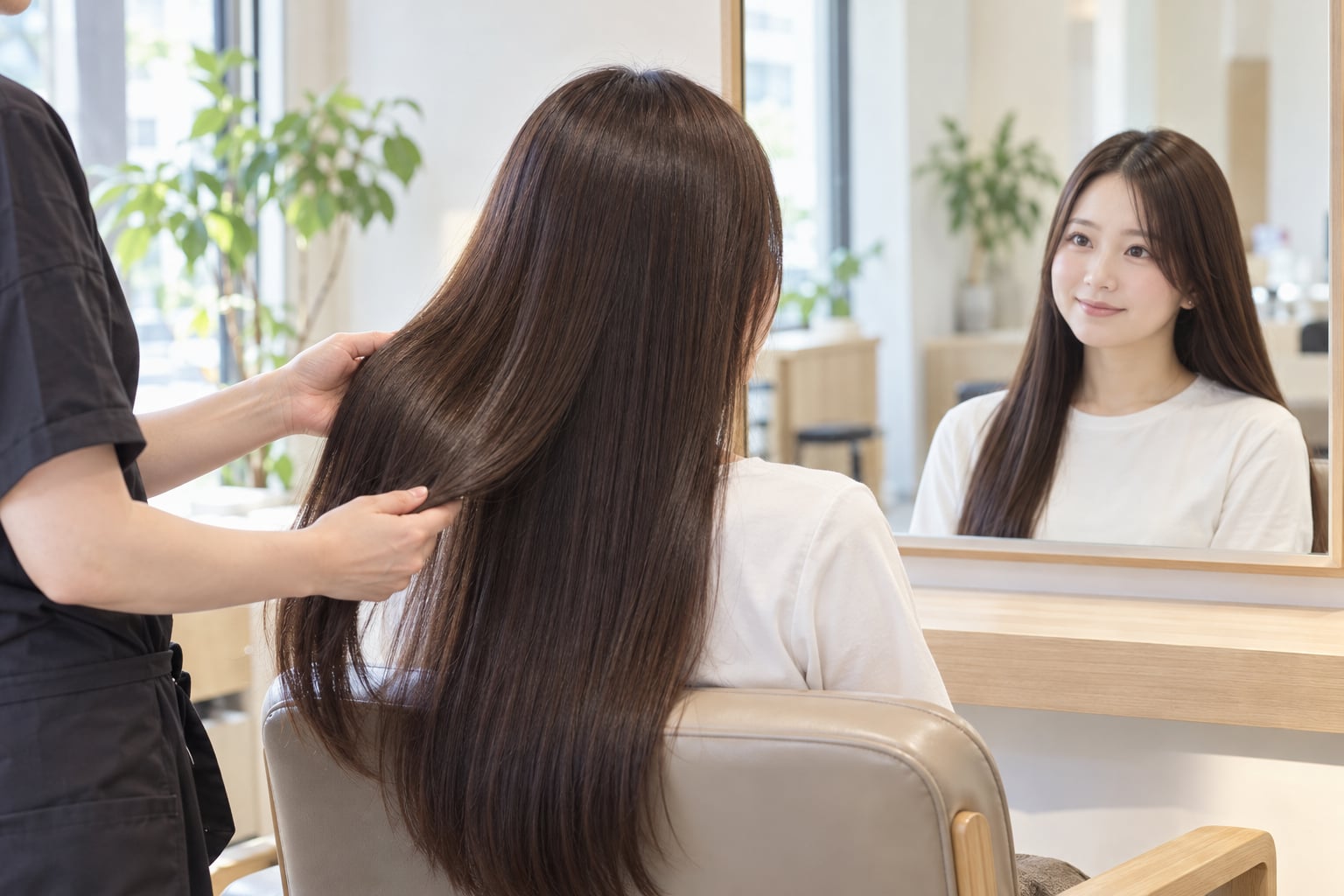
"I want to experience authentic Japanese Hair Straightening (縮毛矯正) during my trip to Japan."
"I have a history of color and bleach treatments, but I'm worried about damage and frizzing."
"I want to know if I can fit it in between sightseeing, how long the treatment takes, and what aftercare is needed."
Japanese hair straightening (thermal reconditioning) is internationally renowned as an advanced hair treatment that semi-permanently smooths even the most stubborn curls and frizz caused by humidity. In recent years, there has been a sharp increase in international visitors seeking treatment at Japan's top salons, drawn by the exceptional level of skill and attentive service.
However, Japanese straightening is a serious treatment that uses strong chemical solutions and a flat iron heated to around 180°C. If the stylist does not have a clear picture of the hair's condition and its history of color or bleach treatments, it can lead to severe damage such as burnt, frizzy ends or even breakage.
This article covers everything you need to know before your trip: how Japanese straightening differs from keratin treatments, what the process actually does to your hair, why bleached hair may be turned away, tips for your pre-treatment consultation, and how to find an English-speaking stylist experienced with a wide range of international hair types.
If you're unsure which salon to choose for your first trip to Japan, or if you'd like to have your pre-treatment hair consultation in English, consider using Japan Salon Booking. You can browse salons by treatment type and language availability to find the perfect match.
Choose your date and area, and send one booking request to up to 4 salons at once.
Find a salon1. Japanese Straightening vs. Keratin Treatment vs. Hair Care: Clarifying Your Goal
Source:Official Guide by Salon Kenji Ribe
Understanding the Differences in Purpose and Longevity to Choose Your Ideal Result
Before booking a hair salon in Japan, take a moment to clarify your goal — what exactly do you want to change about your hair? In Western countries and elsewhere, Japanese hair straightening is known by several names: "Japanese Hair Straightening," "Japanese Straightening," "Thermal Reconditioning," or "Japanese Permanent Straightening." It is often confused with terms such as "Smoothing," "Keratin Treatment," or "Relaxer" — but in Japanese salons, these are treated as strictly distinct service categories, each with a different chemical approach, formula, and longevity of results.
The following is a comparison of each treatment's purpose, chemical mechanism, longevity, and suitable hair types.
If you want to maintain perfectly straight hair even on rainy or humid days without blow-drying, or if you want to be completely free from using a flat iron every morning, Japanese straightening (縮毛矯正) is the most suitable choice.
On the other hand, if you don't want your hair to lie completely flat at the roots, if you want to keep your natural wave while making it more manageable, or if you've undergone repeated bleaching or highlights, choosing a keratin treatment or an acidic heat treatment rather than Japanese straightening is the safer option for protecting your hair.
Basic Information (Featured Recommended Salon: Kenji Ribe)
- Stylist Name: Kenji Ribe (Bilingual Japanese Straightening Specialist)
- Base Salon: Private Hair Salon (Tokyo · Ginza / Yokohama)
- Address: Ginza, Chuo-ku, Tokyo (full address provided upon booking confirmation, as this is a fully private salon)
- Access: A few minutes' walk from Ginza Station on the Tokyo Metro (Ginza Line / Hibiya Line / Marunouchi Line)
- Business Hours: Tue–Sun 9:00–18:30 (Monday and the 1st/3rd Thursday: available at the Yokohama location)
- Official Guide URL: https://hairdresserkenji-ribe.com/japanese-hair-straightening-complete-guide/
- Languages: English, Japanese
- Experience: Handles several hundred clients per year from Western, Asian, and diverse international backgrounds
- Specialties: Low-damage acidic straightening, custom chemical formulation for previously bleached hair
2. How Does Japanese Hair Straightening Change Your Hair? Key Benefits and Things to Know
What Changes Can You Expect? Benefits and Important Considerations
Japanese hair straightening fundamentally alters the internal structure of your hair. While the biggest benefit is a dramatic reduction in daily styling effort, there are important things to understand — because once treated, your natural curl pattern cannot be restored.
4 Key Changes from Japanese Hair Straightening:
1. Treated sections stay permanently straight (your natural curl will not return)
The defining characteristic of Japanese hair straightening is that once a section has been pressed with a flat iron and oxidized with the second chemical solution, it remains permanently straight. Unlike regular treatments that fade within a few weeks, your curl will not come back. Simply blow-drying after a shower instantly revives the beautiful, salon-fresh straightness.
2. A significant reduction in overall volume
Because waves are smoothed from root to tip, overall volume becomes noticeably more compact. This brings dramatic manageability to those troubled by thick or coarse hair that tends to puff out — however, those with finer or thinner hair may find the crown area looks overly flat or sparse. A skilled stylist will apply the chemical a few millimeters away from the scalp to preserve natural root lift.
3. Curls from a curling iron become harder to hold
Because the hair's proteins are heat-set in a straight configuration, curls created with a curling iron after treatment tend to drop out more easily. If you prefer wearing your hair straight day-to-day but want defined curls on weekends, consult your stylist in advance about adjusting the chemical strength or iron heat to leave some flexibility in the hair.
4. The hair's interior is under stress, so daily moisture care is essential
Hair looks glossy right after the treatment, but because the chemical process restructures the bonds inside each strand, internal stress is real. Damage has not disappeared entirely — daily moisturizing treatment is essential to prevent dryness.
3. Why You Should Share Your Full Color, Bleach, and Chemical Treatment History
Quote: SOZO Hair & Make Official Website
To prevent your hair from becoming frizzy or breaking
The single thing Japanese stylists check most carefully is your hair history — what colors, perms, or chemical treatments you have had before. The standard chemicals commonly used in Japan are formulated to thoroughly straighten hard, thick, dark hair and are therefore on the stronger side.
Applied to fine or soft hair, or to hair that has been weakened by repeated coloring or bleaching, these strong chemicals can cause the ends to frizz up severely or cause breakage mid-strand.
5 pieces of history you must share with your stylist:
- Whether you have had bleach, highlights, or balayage within the past two years: Even if only the last few centimeters of your ends have bleach history, you must disclose it. The most dangerous situation is when bleached hair is hidden under a dark color or black dye.
- History of previous straightening, relaxers, or perms: The boundary between newly grown virgin hair and previously treated hair determines how the chemical formulation must be adjusted.
- At-home color, gray coverage, or henna history: Over-the-counter hair dyes and plant-based dyes (henna, indigo) may contain metallic salts, which can cause unexpected chemical reactions with straightening agents.
- Daily flat iron or curling iron temperature: Hair pressed daily at 180°C or above may have undergone heat denaturation, making it susceptible to excessive chemical absorption.
- Your natural wave intensity and any changes in hair texture over time: Changes in hair texture due to hormonal shifts or aging are also important diagnostic information.
Why your stylist may recommend an alternative treatment plan (such as acidic straightening)
Based on a hair assessment, a professional stylist may suggest, "Let's go with a different plan rather than standard Japanese straightening." This is not a refusal — it is an appropriate recommendation to protect your hair from the risk of breakage.
- Reason 1: The ends are bleach-damaged and cannot tolerate an alkaline chemical → Recommendation: "root-only retouch straightening + intensive end treatment" (straighten only the roots while protecting the ends)
- Reason 2: Overall fine hair with partial highlights → Recommendation: "acidic straightening (weakly acidic straightening)," which acts gently in the acidic range near the hair's isoelectric point
- Reason 3: The entire hair is in a state of extreme damage → Recommendation: "keratin smoothing," which bonds keratin with heat without breaking the hair's internal bonds
Basic Information (Featured Recommended Salon: SOZO Hair & Make)
- Salon Name: SOZO Hair & Make
- Address: B1F, 4-25-1 Jingumae, Shibuya-ku, Tokyo 150-0001
- Access: 3 min walk from Meiji-Jingumae Station (Tokyo Metro), 5 min from Omotesando Station, 7 min from Harajuku Station
- Business Hours: Weekdays 11:00–20:00 / Weekends & Holidays 10:00–19:00 (Closed Tuesdays)
- Phone: 03-3478-8692
- Official Website: https://www.sozo-hairmake.com/
- International Client Ratio: Over 50% of all clients are international tourists and foreign residents in Japan
- Staff: A large team of bilingual stylists with professional experience in London and New York
- Payment Methods: Major credit cards (Visa, Mastercard, Amex, JCB, Diners), IC transit cards, and QR code payments accepted
- Deposit Policy: A prepaid deposit system is in place to prevent no-shows from international travelers
4. Request a Pre-Consultation by Sending Photos Before Confirming Your Booking
How Sending Photos in Advance Helps Prevent Day-of Treatment Issues
With limited time in Japan, arriving at a salon on the day of your appointment only to be told 'We're unable to perform straightening on your hair in its current condition' would be a serious waste of your itinerary. Before confirming your booking, choose a salon that offers pre-consultation via online messaging — send photos of your current hair and get a professional assessment in advance.
The 4 photos to send so your stylist can accurately assess your hair condition:
- 1. Back view (full back): Your hair in its entirety, after shampooing and air-drying naturally — no flat iron or heat styling
- 2. Side view: A photo showing curl, frizz, and volume around the face frame, sideburns, and ears
- 3. Crown and roots close-up: A photo showing the strength of the curl in your new growth and the line of demarcation from previous treatments
- 4. Close-up of the ends: A photo showing dryness, split ends, and any remaining bleach or highlights from past treatments
※ By sending unfiltered photos taken under natural indoor lighting, your stylist will be able to advise you not only on whether the treatment is feasible on the day, but also on the estimated duration and exact pricing in advance.
5. Confirm the Full Cost Estimate (Length Surcharges, Cut Fee), Time Required, and Your Travel Schedule
Breaking Down the Total Estimate and Coordinating with Your Travel Plans
Menu listings at Japanese hair salons — such as 'Permanent Straightening from ¥18,000' — often reflect the base price for short hair, with a haircut charged separately. To avoid any surprises at checkout, confirm the following potential add-ons before booking.
- Length Surcharge: As longer hair requires more product, surcharges apply — Medium (+¥1,100–¥2,200), Long (+¥2,200–¥4,400), and Super Long (+¥4,400–¥6,600).
- Volume Surcharge: An additional charge may apply if your hair is exceptionally thick and requires extra flat-iron time.
- Haircut Fee: Confirm whether a haircut is included in the straightening price or billed separately (+¥5,500–¥8,800). Since unevenness at the ends becomes more visible once hair is straightened, a trim is generally recommended.
- Shampoo & Blow-Dry Fee: For standalone treatments, check whether a blow-dry fee (+¥2,200–¥4,400) is charged separately.
※ Prices listed are examples based on confirmed salon rates. Length categories and surcharge structures vary by salon. Before booking, confirm the tax-included total for all services you wish to receive.
Estimating Time Required and Planning Around Your Travel Schedule:
Permanent straightening is among the most time-intensive services at any salon. Allow approximately 3 to 4.5 hours (or close to 5 hours for long or thick hair, or if combined with a repair treatment).
- Do not schedule your appointment immediately before a flight, Shinkansen, or reserved restaurant — overruns of 30 minutes to an hour are not uncommon.
- A morning slot around 10:00 AM is ideal — you will finish by around 2:00–3:00 PM, leaving the rest of the day free for sightseeing and dinner.
- Avoid onsen, sauna, or pool visits on the same day — as you should not get your hair wet on the day of treatment, plan any spa activities for a separate day.
6. Post-Treatment Care for the First 48 Hours, Home Care After Returning Home, and Root Touch-Up Frequency
Science-Based Hair Care and a Long-Term Maintenance Plan
Immediately after a permanent straightening treatment, your hair is set straight but remains extremely delicate and unstable. Applying strong tension or getting it wet during this period can cause creases and unwanted bends to become permanently set.
What to Avoid in the First 24–48 Hours After Treatment:
- Do not wet or wash your hair: Avoid shampooing on the day of treatment and keep your hair away from shower water for the period your stylist specifies (24–48 hours).
- Do not tie your hair with tight elastics or secure it with bobby pins: Tying your hair will cause elastic marks to permanently set in. Avoid scrunchies and clips even while eating, and refrain from tucking your hair behind your ears for a few days.
- Avoid hats and headbands: Accessories that press firmly against the head can leave permanent crease marks in the hair.
Home Care and Root Touch-Up Schedule After Returning Home:
- Use a mildly acidic, amino acid-based shampoo: Avoid commercially available, high-lather shampoos based primarily on petroleum-derived surfactants, and switch to a gentle amino acid-based formula such as those sold at professional salons.
- Blow-dry your hair completely before going to sleep: Sleeping with wet hair causes friction against the pillow, lifting the cuticle and leading to significant damage.
- Root Touch-Up Maintenance Cycle: Every 4 to 6 Months: The sections treated with Japanese hair straightening will remain straight semi-permanently, but your new root growth will return to its natural texture. On your next salon visit, rather than applying the chemical to your entire hair, ask for a "retouch" (リタッチ) — a treatment applied only to the newly grown roots.
7. How to Choose a Salon and Stylist Experienced with Non-Japanese Hair Types and English Communication
Source:Number76 Tokyo Official Website
3 Key Criteria for Evaluating a Salon's Multicultural Experience and Chemical Selection Expertise
Japan is home to tens of thousands of hair salons, but not every salon will deliver consistent results for international visitors seeking Japanese hair straightening. While most Japanese salons are highly practiced at straightening the fine, dark hair typical of Japanese clients, many have limited experience selecting the right chemicals for the wide range of hair types found around the world — from fine, soft hair to tightly coiled, curly hair.
3 Essential Checkpoints for Choosing the Right Salon:
- 1. Does the salon regularly post Before/After treatment photos of multicultural clients on their official social media?: Check the salon's official Instagram or website to confirm they feature a substantial number of Japanese hair straightening cases performed on international clients.
- 2. Is a pre-treatment consultation available in English?: Choose a salon with English-speaking stylists on staff, so you can communicate every detail of your hair history and desired results without any ambiguity.
- 3. Does the salon apply different chemical formulations according to each section's damage level?: Verify that the salon employs stylists skilled in applying multiple chemical formulas — with varying alkalinity and reduction concentrations — to different sections of the hair: healthy roots, mid-lengths, and more damaged ends.
Basic Information (Featured Recommended Salon: Number76 Tokyo)
- Salon Name: Number76 Tokyo
- Address: Jingumae MM Building 2F, 4-9-2 Jingumae, Shibuya-ku, Tokyo 150-0001
- Getting There: 5-minute walk from Omotesando Station (Exit A2) on the Tokyo Metro; 7-minute walk from Meiji-Jingumae Station
- Opening Hours: Tuesday–Sunday, 10:00–19:00 (Closed Mondays)
- Phone: 03-5786-1642
- Official Website:https://www.number76.com/
- Global Presence: An internationally oriented salon with locations in Kuala Lumpur (Malaysia), Singapore, and Indonesia, in addition to Tokyo
- Languages Spoken: A cosmopolitan team of stylists available to assist in Japanese, English, and Chinese
- Menu Highlights: A rich selection of combination treatments, including acid-based hair-quality straightening and TOKIO INKARAMI treatment packages
Conclusion
With the right salon choice and a thorough consultation, Japanese hair straightening can dramatically simplify your morning styling routine and become one of the most memorable highlights of your trip.
The three keys to a successful treatment are: being fully honest with your stylist about your complete history of coloring and bleaching; allowing a relaxed schedule of at least three to four and a half hours for the appointment; and choosing a salon that is experienced with non-Japanese hair types and can communicate with you fluently in English.
Choose your date and area, and send one booking request to up to 4 salons at once.
Find a salonReviewed by
菊池 拓人
Hairdresser / Head of Platform Business, CODRiSE Inc.
Licensed hairdresser in Japan. Spent about 12 years at large salons in Tokyo, in areas such as Kamikitazawa, Nakano and Kichijoji, specialising in men's cuts and perms and working as a stylist and assistant manager. Still works on the salon floor today, alongside leading the platform business at CODRiSE Inc.
Last reviewed: 2026-11-02
Frequently asked
Can I really get a hair straightening treatment even if I don't speak Japanese?
It may be possible. Language support varies by salon and stylist, so please check before you book. Preparing photos of the look you want and sharing photos of your hair and your treatment history in advance makes it easier to agree on the result.
Can I get a hair straightening treatment if I have bleached or highlighted hair?
Whether the treatment is possible depends on the extent of damage and how many times your hair has been bleached. In cases of significant damage, a standard straightening treatment may not be recommended—but your stylist can suggest safer alternatives, such as switching to an acid-based straightening treatment, a root-only retouch to protect the lengths, or combining the service with an intensive conditioning treatment.
Can I wash or tie up my hair on the day of the treatment?
Your hair is in a delicate state immediately after the treatment as the straightening sets. Avoid shampooing or getting your hair wet for 24–48 hours after the service. Tight hair ties or clips can also leave indentations during this window, so we recommend keeping your hair down and allowing the straight style to set naturally for a few days.
How long does the treatment take? How should I plan my travel schedule around it?
Japanese hair straightening typically takes between 3 and 4.5 hours on average. If you have long or thick hair, or plan to add a conditioning treatment, it may take longer. To avoid any stress, we recommend booking a morning appointment and keeping the rest of your day open—avoid scheduling flights or dinner reservations immediately after your salon visit.
Is tipping expected at Japanese salons? Can I pay by credit card?
Tipping is not part of Japanese salon culture—simply pay the total price shown and you're all set. Most salons accept major credit cards and cashless payment methods, though it's a good idea to confirm which card brands are accepted before your visit.