
What's the Difference Between Japanese Straightening and Keratin Treatment? Key Questions to Ask Your Stylist
Although Japanese straightening and keratin treatment may seem similar, they differ in purpose and results. Here we compare each treatment's characteristics, longevity, and maintenance requirements — and walk you through how to choose the right one for your hair and what to confirm with your stylist before booking.
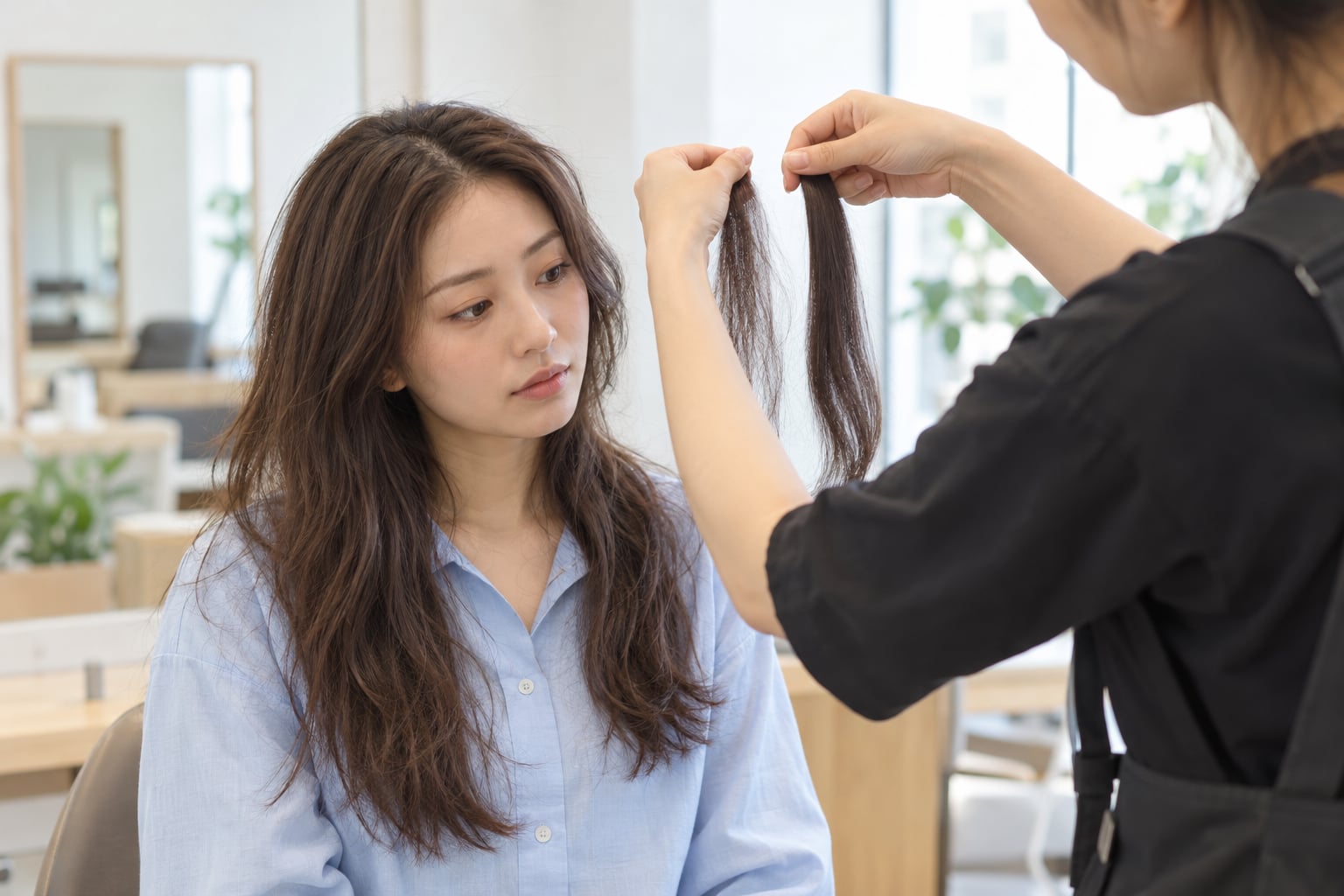

If you're bothered by frizz or unruly hair, you may have considered Japanese straightening or a keratin treatment.
But it can be hard to know exactly how the results differ — or which option is right for your hair type.
Japanese straightening uses chemical agents and the heat of a flat iron to permanently straighten hair with strong curl or wave. Keratin treatment, on the other hand, uses products formulated with keratin — the protein that makes up hair — to tame frizz and boost smoothness and shine.
However, results and longevity vary depending on the products and techniques used, and your color or bleach history can also affect which treatment is right for you.
If you're going to invest in a treatment, it's worth understanding the differences so you can achieve the results you're truly after.
This article compares Japanese straightening and keratin treatment in depth — covering their characteristics, how to choose between them, and the questions you should ask your stylist.
Choose Based on Your Goal: Pin-Straight or Smooth and Glossy?
When deciding between Japanese straightening and keratin treatment, start by picturing exactly what you want your hair to look like.
If you have naturally strong curl or wave from the roots and want sleek, pin-straight hair, Japanese straightening is the better fit.
If you want to keep coloring your hair while taming dryness and coarseness for a smooth, glossy finish, keratin treatment is the recommended choice.
Some products are formulated to work safely on color-treated or bleached hair.
However, even for the same frizz issue, the right treatment differs depending on whether the cause is natural curl or damage from coloring and heat styling.
Some keratin treatments are also designed to reduce curl and bring hair closer to straight, so choosing a service that matches your specific goal is essential.
Start by clarifying your hair concerns and ideal results, then discuss them with your stylist.
Compare the Details, Not Just the Name
Even when a salon offers the same treatment by name, the products and processes used can vary considerably from one salon to another.
Keratin treatments in particular come in a wide range of formulations — from those that care for the hair's inner structure or surface to those that use heat to lock out frizz and waves.
Japanese straightening results also vary depending on the chemical agents used, the flat-iron temperature, and the technique, so the name alone tells you very little.
When comparing services, ask about the product name and ingredients, what the chemicals do, and whether heat processing is involved.
For example, some keratin treatments require a flat-iron heat-sealing step and are not simply a matter of replenishing keratin in the hair.
To find the treatment that best matches your desired outcome, ask your stylist to walk you through the specifics of each option.
Differences in Results, Longevity, and Maintenance
Japanese straightening and keratin treatment differ not only in results, but also in how long they last and how they should be maintained.
Japanese straightening uses specialized chemicals and flat-iron heat to semi-permanently transform stubborn curly or frizzy hair into smooth, straight hair.
The straightened sections stay straight, but after about three to six months, new growth at the roots will start to show its natural texture again.
Since newly grown hair will return to its natural curl, touch-up treatments targeting the roots will be necessary if you want to maintain fully straight hair.
Keratin treatment, unlike Japanese straightening, does not permanently eliminate curl — rather, it controls frizz and dryness to give hair a smoother, more manageable finish.
The overall improved manageability can make hair appear straighter than before.
Results typically last around two to three months, gradually fading as the hair returns to its natural state.
Both treatments require regular upkeep to maintain your desired results.
Your Color and Bleach History Affects Your Options

If your hair has been colored or bleached, the condition of your hair will determine which treatments are suitable for you.
Hair that has been bleached multiple times tends to carry significant damage, and whether Japanese straightening is feasible requires careful professional assessment.
Past coloring, bleaching, highlights, and previous straightening treatments can all affect how your hair responds to chemicals and what results you can expect.
Some keratin treatments are formulated for color-treated or bleached hair and are effective at restoring shine and manageability.
However, since compatibility varies by product, you cannot simply assume that bleached hair rules out Japanese straightening and makes keratin treatment the automatic choice.
When booking, share details with your stylist — how many times you've colored or bleached, when you last did so, and any history of Japanese straightening — so they can assess your hair's current condition before recommending a treatment.
Check the Products, Process, and Compatibility with Your Hair
Before booking Japanese straightening or a keratin treatment, ask your stylist about the products and steps involved.
Keratin treatments vary by product in their ingredients, whether heat processing is required, and whether they are safe for color-treated hair.
With Japanese straightening, the chemical agents, flat-iron temperatures, and damage-minimizing steps also differ from salon to salon.
Rather than choosing by name alone, ask which specific products will be used and how the treatment will proceed — it gives you peace of mind.
Also confirm that the treatment is appropriate for your hair type, current condition, and color or bleach history.
If you have any concerns, it is a good idea to discuss them in detail during the pre-treatment consultation before making a final decision.
Compare Treatment Time, What's Included in the Price, and Aftercare
When comparing the two treatments, look beyond time and cost — also check what is included in the service and how you should care for your hair afterward.
Japanese straightening typically takes around three to three and a half hours, including cut, shampoo, and blow-dry.
Keratin treatment generally takes one to two and a half hours, though some formulations can require two and a half to four hours.
Prices also vary by salon; keratin treatment generally ranges from ¥15,000 to ¥30,000.
The final price can change depending on whether the listed rate includes a cut, shampoo, blow-dry, conditioning treatment, or long-hair surcharge.
Post-treatment aftercare is another important point to clarify.
After Japanese straightening, stylists often advise avoiding shampooing, tying your hair, or tucking it behind your ears for the first 24 to 48 hours.
Going forward, the key to maintaining your results is never leaving hair damp — always dry it thoroughly with a blow-dryer.
With keratin treatment, some products also require you to wait around 24 hours before shampooing.
For both treatments, washing with very hot water or a harsh, clarifying shampoo should be avoided — gentle cleansing helps prolong the results.
Rather than deciding on time and price alone, compare the post-treatment care requirements too, and choose the option that fits most naturally into your daily routine.
A Checklist of Questions to Ask Your Stylist When Booking
The right choice between Japanese straightening and keratin treatment depends on your hair type and its current condition.
When booking or during your consultation, use the following checklist with your stylist.
・Is this treatment suited to my hair type and the strength of my curl?
・Will my history of coloring, bleaching, or past straightening treatments affect the outcome?
・What products and chemicals will be used?
・How straight will my hair be after the treatment?
・How long will the treatment take and what will it cost?
・Are there any additional charges that may apply?
・How long will the results last?
・When should I schedule my next appointment?
・How long after the treatment before I can shampoo or tie my hair?
・What at-home hair care routine should I follow?
In particular, sharing as much detail as possible about your coloring, bleaching, and previous straightening history will help everything go smoothly.
Also be specific about the results you're after — for example, "I want my curl completely eliminated" or "I just want my hair to fall naturally and look polished."
Covering these points in advance reduces the chance of being disappointed with the results and makes it much easier to choose the treatment that is truly right for your hair.
Reviewed by
菊池 拓人
Hairdresser / Head of Platform Business, CODRiSE Inc.
Licensed hairdresser in Japan. Spent about 12 years at large salons in Tokyo, in areas such as Kamikitazawa, Nakano and Kichijoji, specialising in men's cuts and perms and working as a stylist and assistant manager. Still works on the salon floor today, alongside leading the platform business at CODRiSE Inc.
Last reviewed: 2026-11-02
Frequently asked
What is the difference between Japanese straightening (縮毛矯正) and keratin treatment?
Japanese straightening (縮毛矯正) uses chemicals and the heat of a flat iron to permanently straighten hair with strong curl or waves at the root. Keratin treatment uses products infused with keratin — the protein that makes up hair — to reduce frizz and add smoothness and shine.
Which one should I choose?
If you have naturally strong curl or root-level waves and want sleek, pin-straight hair, Japanese straightening is the better fit. If you want to keep coloring your hair while taming frizz and dryness for a smooth, glossy finish, keratin treatment is the more suitable option.
How do the two treatments compare in terms of longevity?
Japanese straightening permanently keeps the treated portions straight, though new growth at the roots typically becomes noticeable after about three to six months. Keratin treatment lasts roughly two to three months, gradually returning the hair to its natural state over time.
Can I get either treatment if I have bleached hair?
It depends on the condition of your hair. Bleached hair accumulates damage over time, so whether Japanese straightening is safe requires careful assessment — it cannot simply be said that "bleached hair rules out straightening but allows keratin treatment." Be sure to tell your stylist how many times you have colored or bleached your hair, when you last did so, and whether you have had Japanese straightening done before.